The risk you cannot see
The estate grew faster than the map: suppliers, SaaS bought outside IT, open APIs, forgotten test environments. You protect what you inventoried, and the inventory is old.
Risk analysis, compliance, penetration testing and governance — powered by Elyys360, the GRC platform we build.
What changed is not how demanding the regulations are. It is that proof became continuous, while most arrangements stayed annual. What follows describes what we find on engagements.
The estate grew faster than the map: suppliers, SaaS bought outside IT, open APIs, forgotten test environments. You protect what you inventoried, and the inventory is old.
Hours spent filling in questionnaires that change no decision, while fixes wait. The budget goes into demonstration, not into reducing risk.
The organisation does things properly and cannot show it. At the moment of an audit, a tender or an incident, missing proof counts as a missing control.
Different maturities, different sectors, the same three failures.
Four workarounds, found everywhere. None of them reduces risk: they document that it exists.
Current the month of the audit, frozen for the other eleven.
Self-declared, annual, never cross-checked. You measure the quality of the answers, not of the supplier.
Two hundred pages, no dated action, no named owner. The report exists; so does the risk.
The subject becomes a priority the day it becomes public.
A complete arrangement is priced like a programme, while the risk does not pause during the budget debate.
Between the decision and the first usable proof, more than a year often passes. The exposure runs for the whole of it.
Nobody is positioned to say which finding to treat first, for lack of a rating that engineering and leadership read the same way.
The choice came down to funding a programme or hoping. For years, hoping usually won.
A finding is only worth something dated, assigned and tracked. The smallest useful unit is not the audit: it is the corrective action, with an owner, a deadline and a re-test. Anything short of that granularity ends up filed.
Genuinely exploitable attack paths, configuration defects, external exposure, critical third parties. What an attack actually goes through.
Risk rating, acceptance decisions, evidence of execution. What an auditor, an insurer or a client will ask you to show.
A critical vulnerability is reported the day it is found, not the day the report is ready.
Technical evidence your teams can replay. A finding you cannot reproduce does not get fixed: it gets debated.
An owner, a deadline, an effort estimate. Without that, prioritisation falls to whoever read the report last.
The same matrix serves the technical session and the leadership summary. Two readings, one rating, the same day.
At the end of the plan, the tests are replayed. A remediation declared is not a remediation observed.
The gain does not always take the form of a closed risk. It comes in four shapes, and they are not equivalent.
The real estate replaces the assumed one, including the assets nobody claimed any more.
Evidence is produced once and reused, instead of being rewritten for every requester.
A shared rating finally lets you say what you treat, what you accept, and why.
The plan is steered in your own tools. Nothing forces you back through us to know where you stand.
Identify exploitable attack paths and provide actionable recommendations.
Turn regulations and standards into a roadmap that serves the business.
Prepare for, detect and contain incidents alongside your teams.
Scope, objectives, operational constraints and points of contact. Nothing starts before a scoping note is approved by your teams.
Audit, penetration testing or compliance interviews depending on the engagement. Any critical vulnerability is reported to you immediately, without waiting for the report.
Two levels of reading: a technical session with your teams, a summary for leadership. Both on the same day.
Every finding becomes a dated action with an owner and an effort estimate. A report without an action plan never gets implemented.
It depends on scope: two to three weeks for one application, several months for a full information system. Scoping settles that question before you commit, not after.
No for a compliance audit or risk analysis. For a penetration test, we agree a window and written rules of engagement setting out what is allowed and what is not.
Experienced consultants, named in the quotation. We do not put a junior alone on an engagement, and the person who answered you is the one who shows up.
The action plan gets steered. You can do that in your own tools, or in Elyys360, the platform we publish, where each finding becomes a tracked action.
No. Our consulting engagements are independent of the platform and run identically without it. Elyys360 steers what comes next; it does not perform the audit.
We do not resell someone else's platform: we write it. Here is what it does, screen by screen.
Rate impact and likelihood, add mitigations, and residual risk recalculates as the actions land. The Current / Initial switch shows the ground covered.
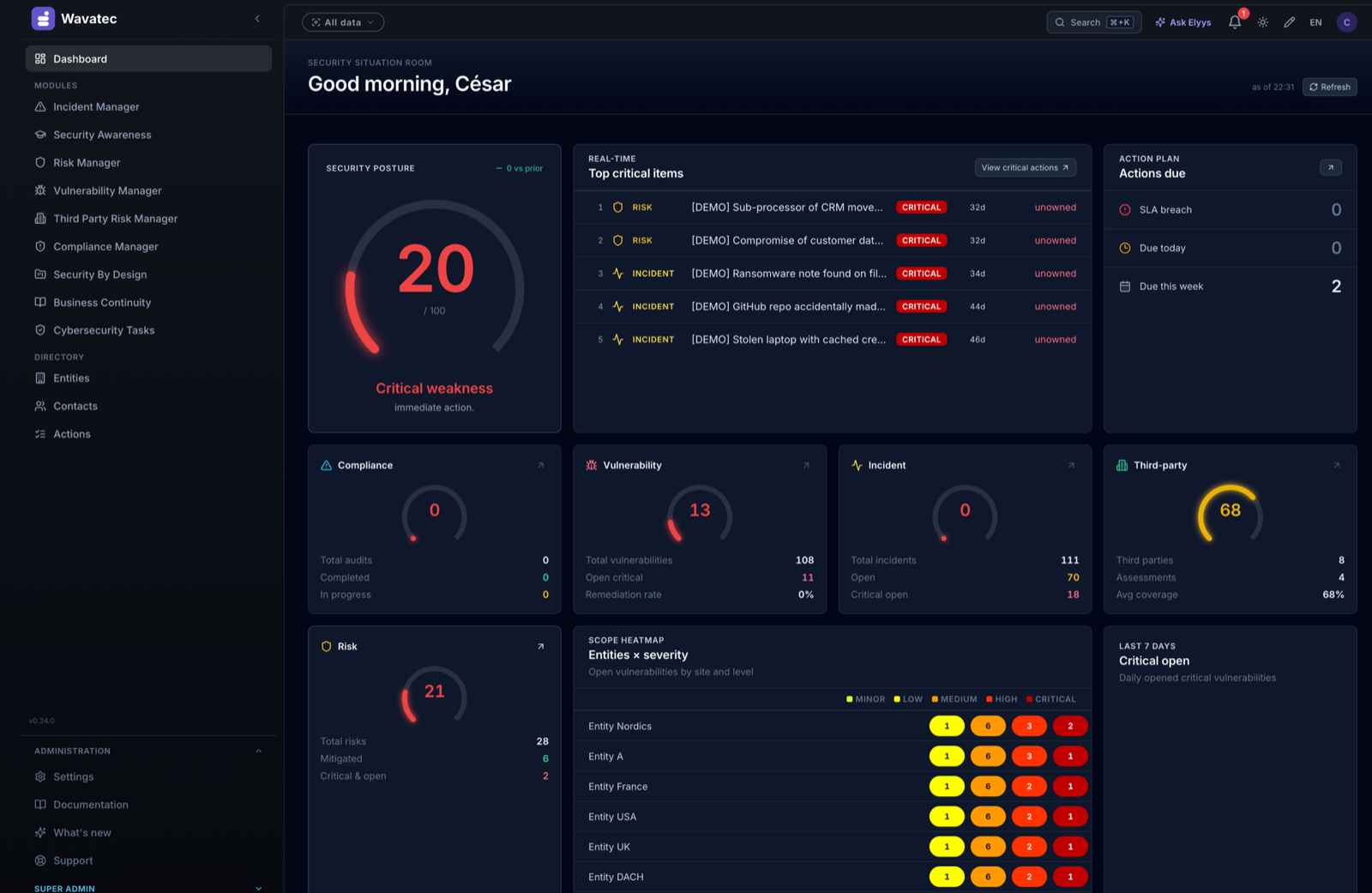
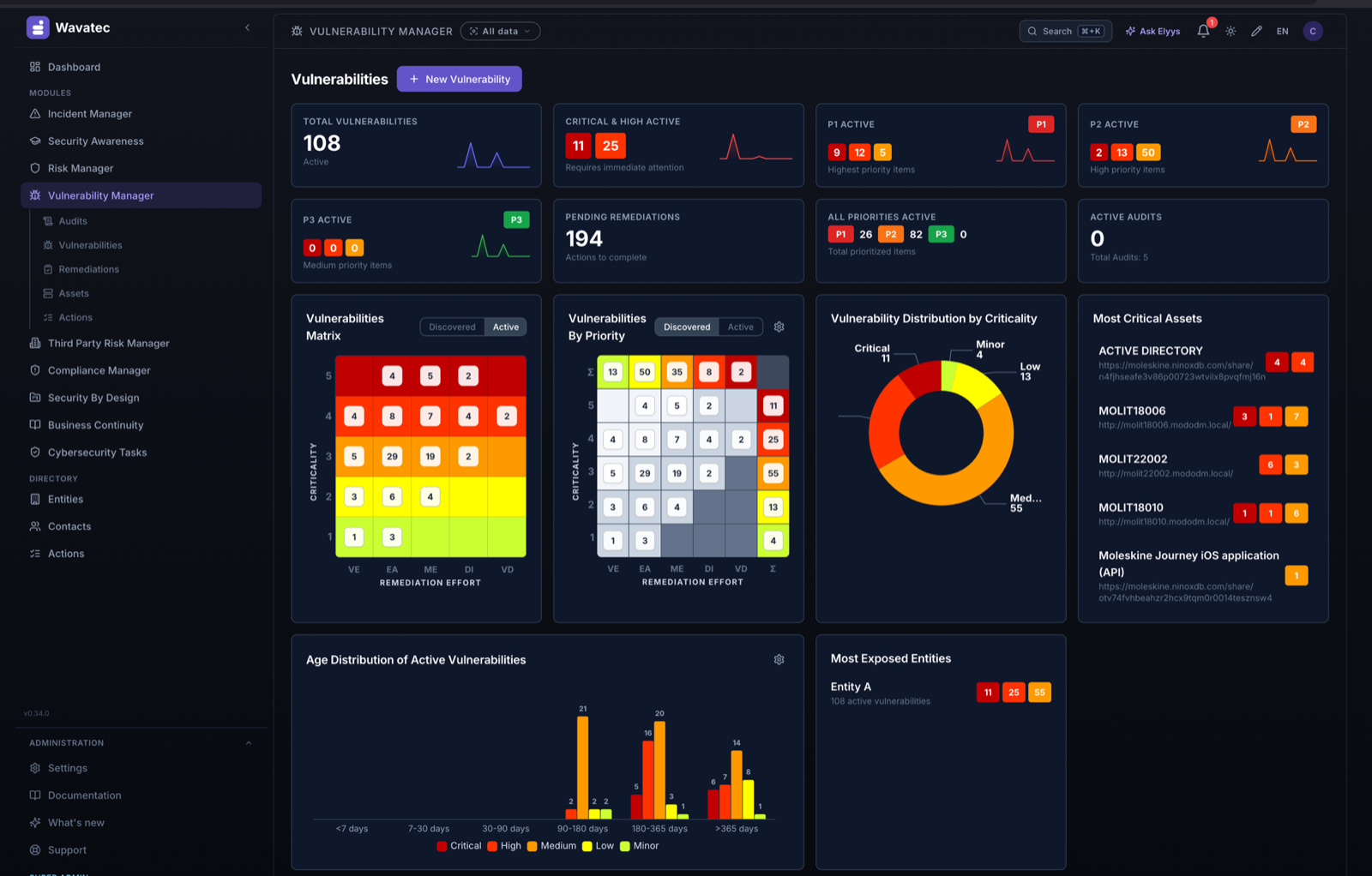
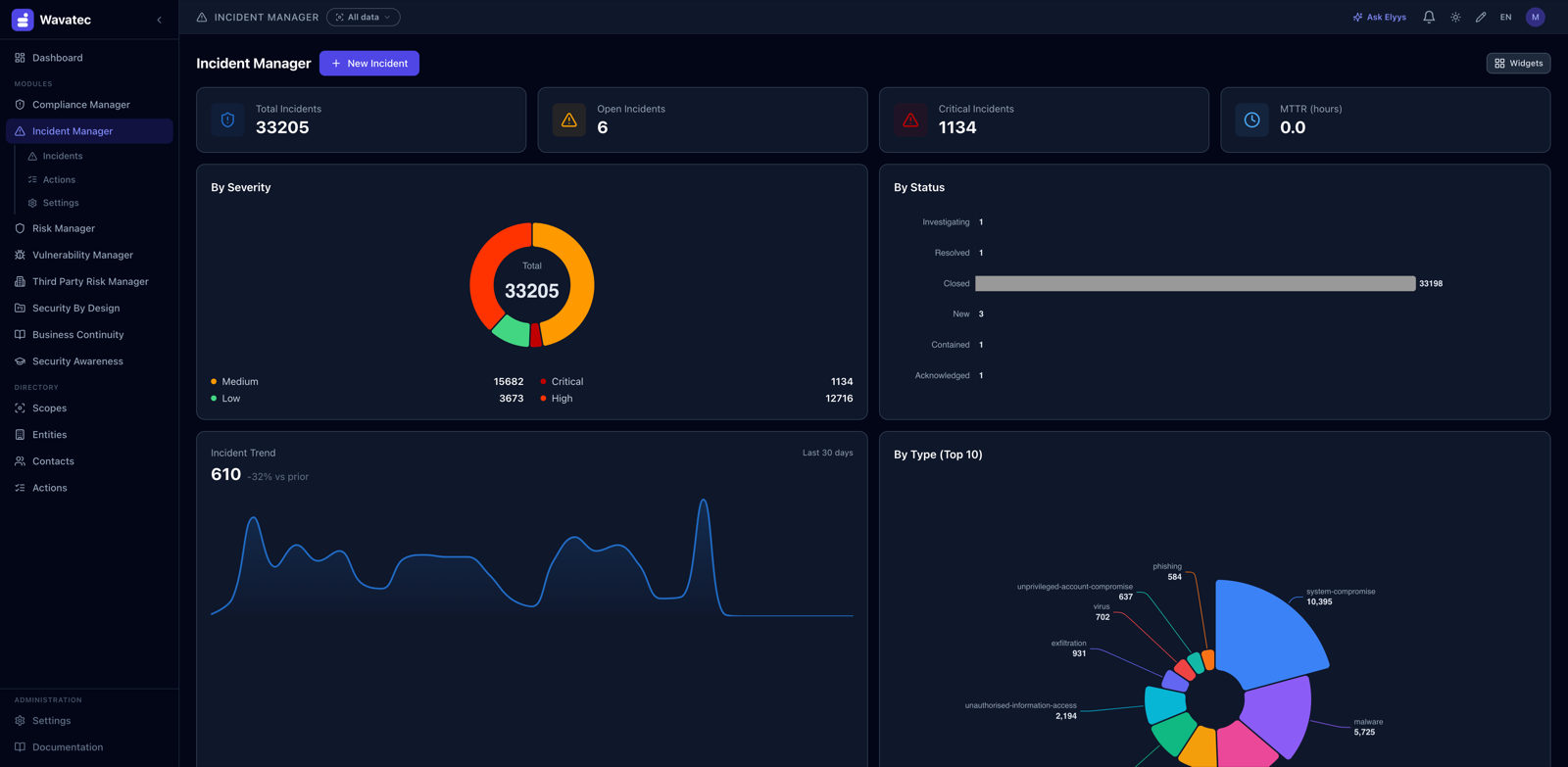
From compliance audits to risk scenarios, from vulnerability management to incident response: the whole posture is steered from a single platform.
Build named filtered views that apply across every module. Group entities, compose scopes, switch context from the global selector.
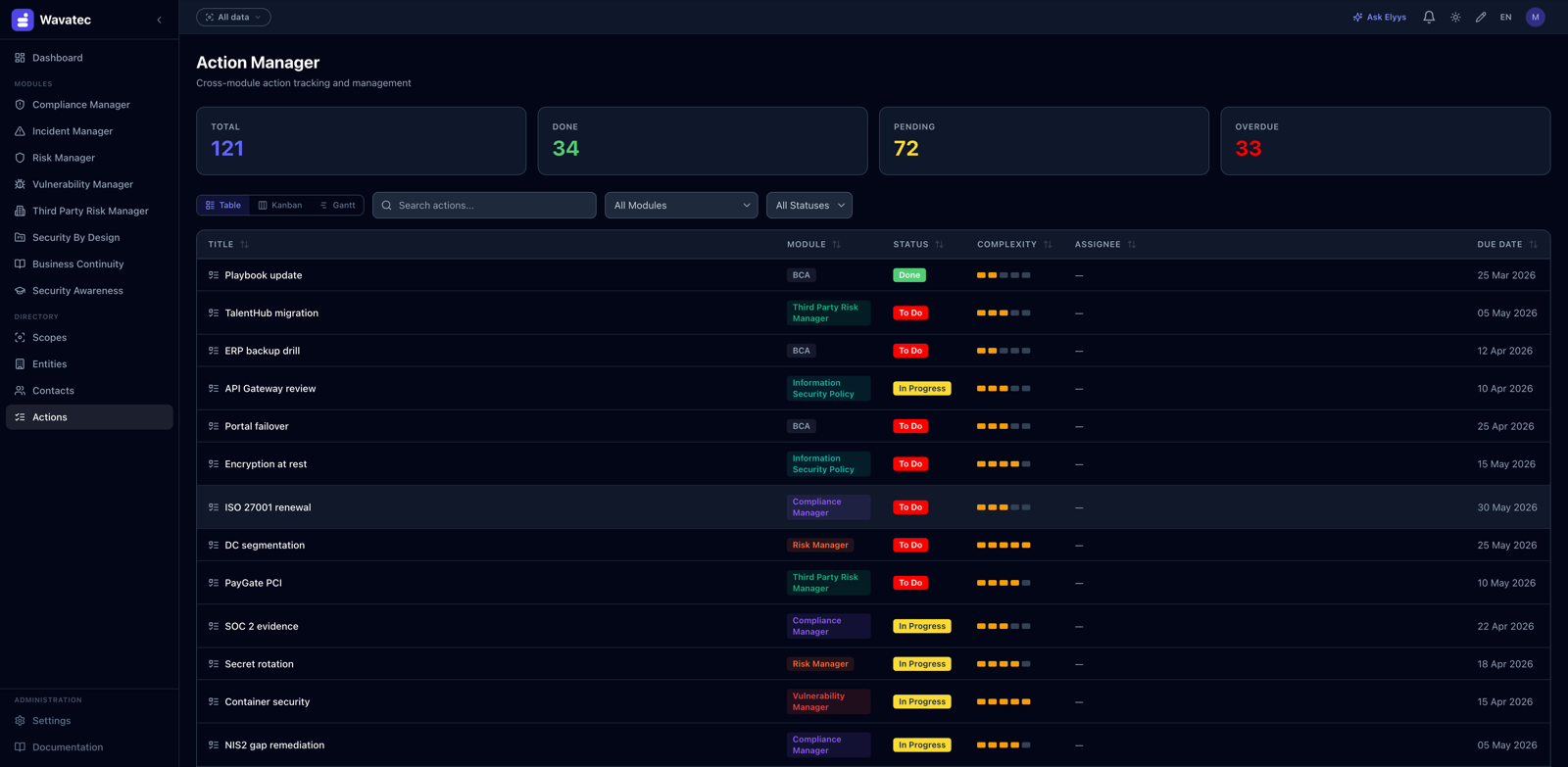
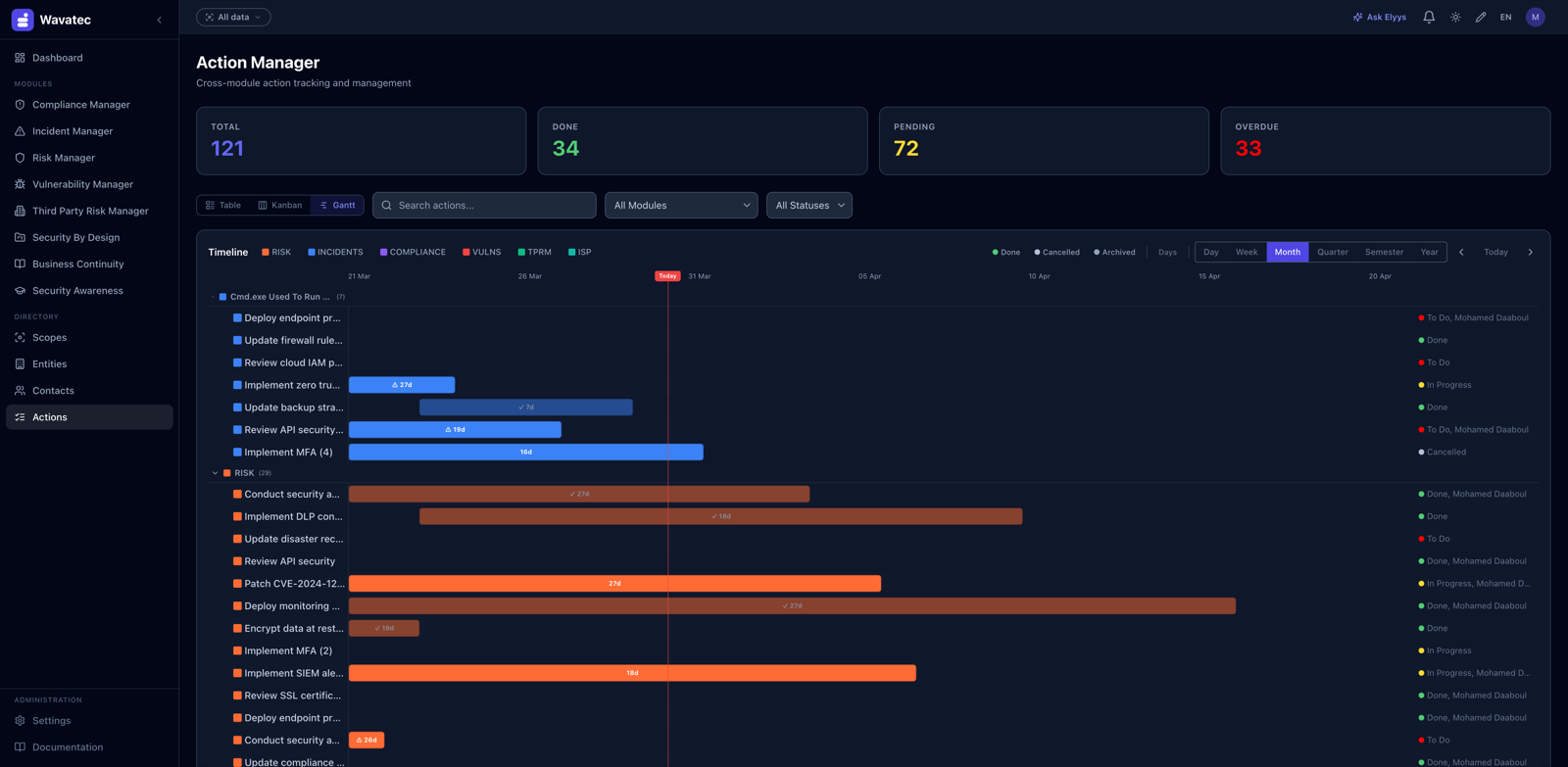
Every module feeds the same action plan. Drag to reschedule, assign RACI roles, track progress without stitching three spreadsheets together.
For each risk scenario the platform proposes mitigations with their estimated impact — enough to decide, not enough to replace the analyst.
Compliance, risk, vulnerabilities, TPRM: every action on one timeline. Drag to reschedule, resize to move a deadline.